
Catalina™ by
Avix Medical
A new way to characterize
breast tumors — in real time,
at the point of care.



Catalina™ by Avix Medical, Inc. is an investigational device. Avix Medical has completed an FDA Pre-Submission and received Agency feedback on a 510(k) pathway. Catalina is not currently cleared or approved by the FDA and is not available for commercial sale.
Catalina: closing the gap in breast cancer care.
Featuring Avix's Chief Technology Officer and Chief Medical Advisor.
Catalina is an investigational device and is not currently cleared or approved by the FDA.
1 in 8 women in the U.S. will be diagnosed with breast cancer in her lifetime.1 Avix was founded on the conviction that timely information should belong to every patient, not only those with access to specialty care.
Hear from Avix's Chief Technology Officer, Aditya Ranganathan, PhD, and Chief Medical Advisor, Evanthia Roussos-Torres, MD, PhD, on where breast cancer detection stands today, and where Catalina fits in.
1American Cancer Society, 'Key Statistics for Breast Cancer,' Cancer.org, 2026.
Timing Matters
When a lump is found in the breast, the wait for answers begins. Finding out can take weeks.
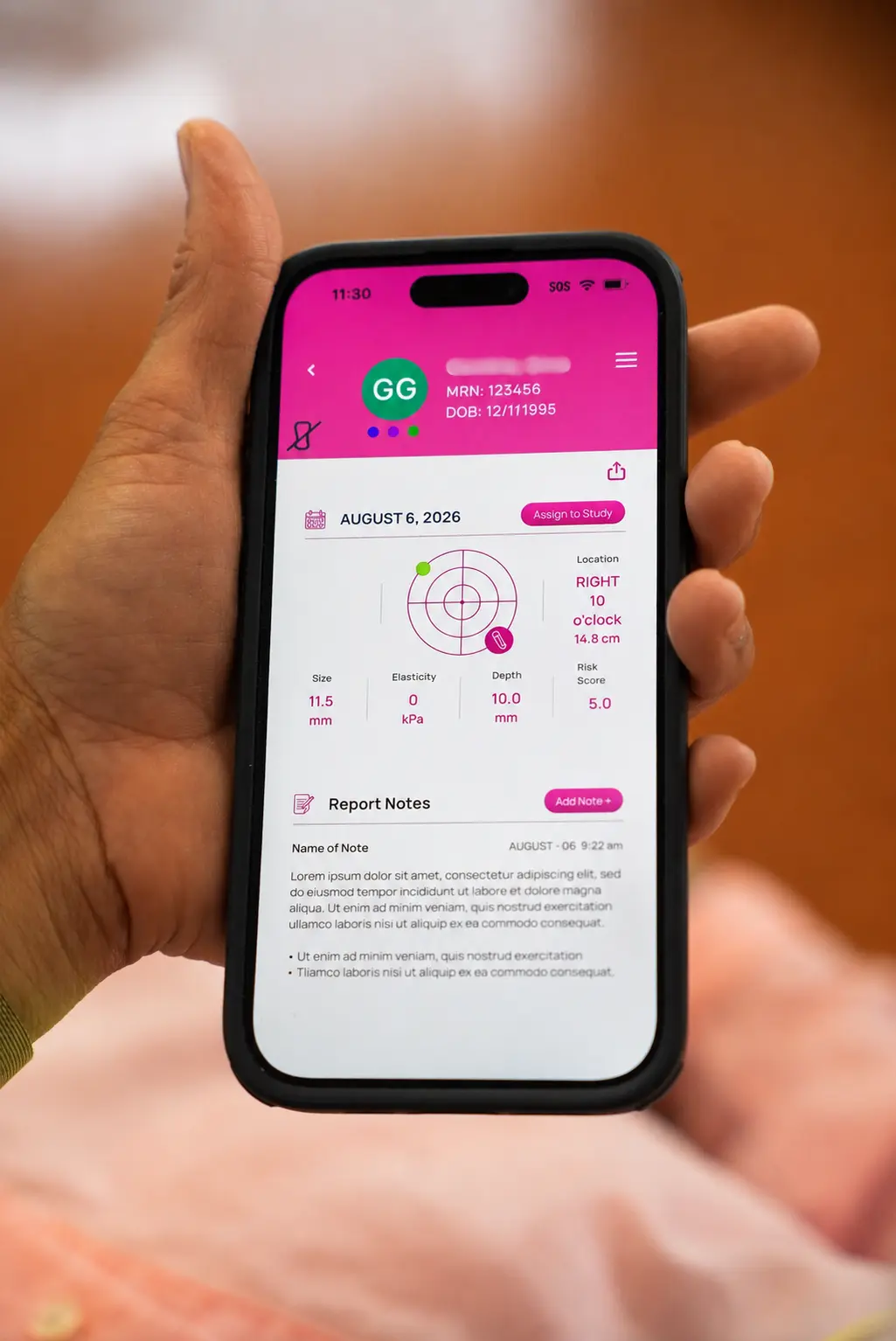
Catalina is designed for the evaluation of palpable breast masses at the point of care. It measures size and stiffness and returns a malignancy score in under 60 seconds.
New breast cancer cases worldwide, 2022
IARC Global Cancer Observatory, GLOBOCAN 2022
Breast cancer deaths worldwide, 2022
IARC Global Cancer Observatory, GLOBOCAN 2022
Average wait from abnormal mammogram to biopsy among U.S. Medicare patients. And that’s before pathology.
SEER-Medicare analysis of 53,758 patients, Annals of Surgical Oncology, 2020
U.S. five-year survival once breast cancer has spread to distant organs, compared with 100% when it’s found while still localized
NCI SEER Cancer Stat Facts: Female Breast Cancer (2016–2022 data)
INTRODUCING CATALINA
Real-time tumor characterization, at the point of care.
Designed for the evaluation of palpable breast masses, Catalina is a handheld, radiation-free device that uses a patented lightwave tactile sensor to give clinicians quantitative information about breast tumors in real time, during the exam.
- MEASURES
- Tumor size, depth, and stiffness
- Delivers
- A malignancy risk score in under 60 seconds
- Connects
- To companion app via Bluetooth
What Catalina is designed to support
- Timing
- Triage
- Patient experience
- Tracking
- Cost
- Timing
Earlier answers
Quantitative information about a tumor during the visit, rather than across weeks of sequential appointments.
- Triage
Better triage
Objective measurements to support clinicians' decisions about which tumors warrant escalation.
- Patient experience
Better patient experience
No radiation and no painful compression. Results in under 60 seconds.
- Tracking
Tracking over time
Because Catalina produces a structured, quantitative record, findings can be compared across visits rather than described from memory.
- Cost
Lower cost of care
A portable device designed to be low-cost, bringing quantitative information into any exam room without dedicated imaging equipment.