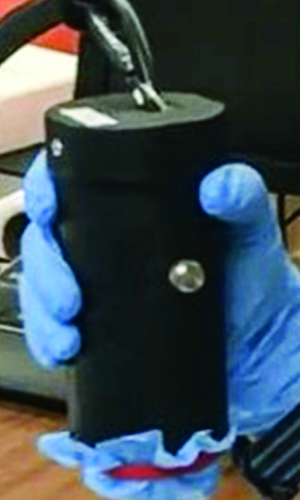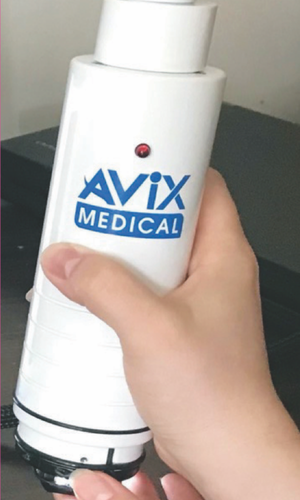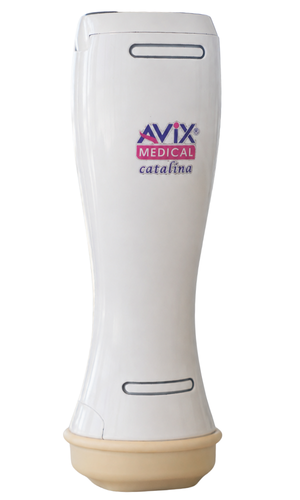
The science behind Catalina™.
Catalina measures the size and stiffness of a breast tumor using a patented optical tactile sensor.
The mechanism
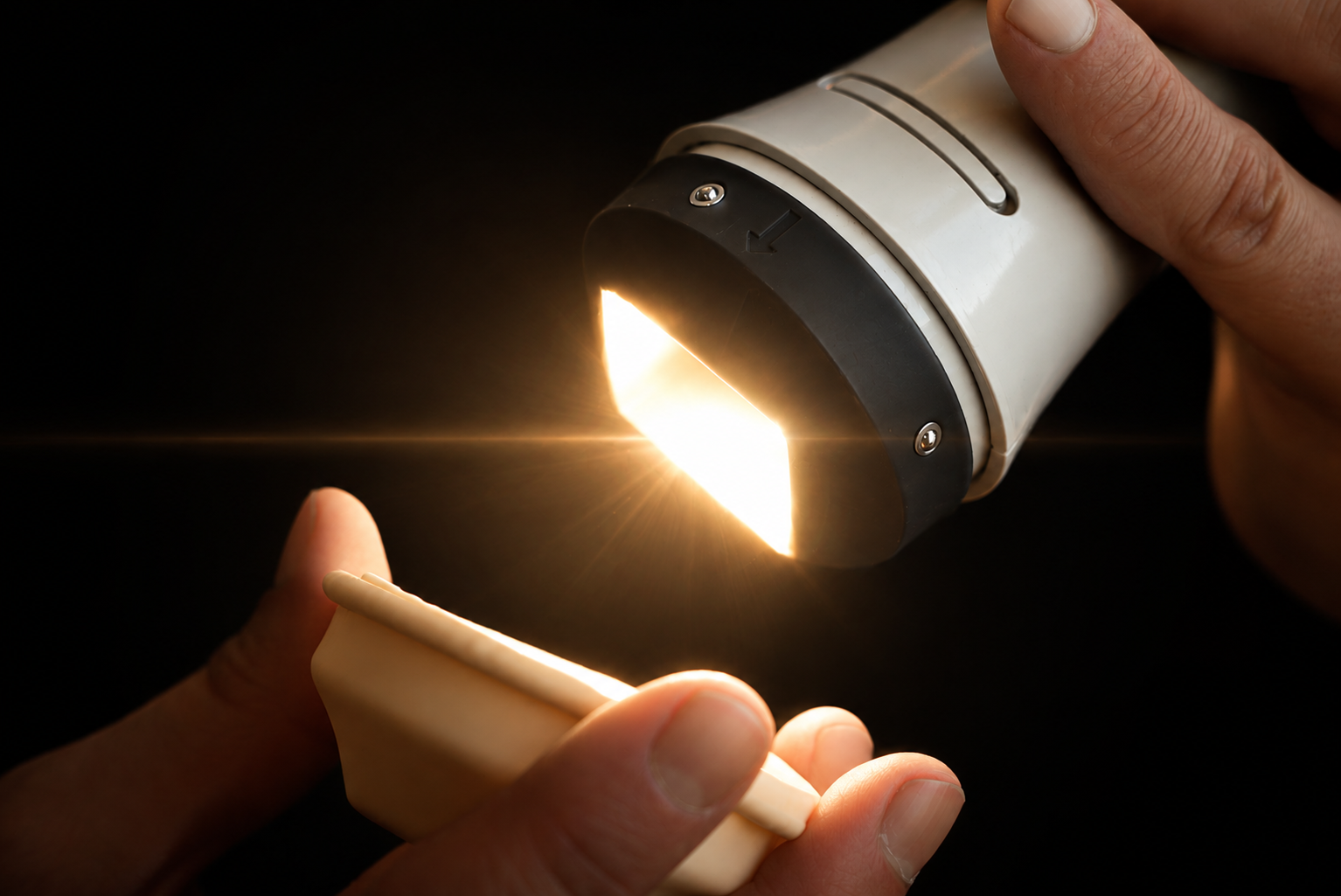
Our optical tactile sensor enables real-time assessment of a tumor's size and stiffness.
Catalina uses an optical waveguide made from a transparent, tissue-like polymer. LEDs illuminate the waveguide, and light is trapped inside it by internal reflection. When the clinician presses the device against the breast, tissue beneath the surface deforms the polymer, and that deformation causes light to scatter out of the waveguide. This continuous-surface sensing is different from the discrete sensor arrays used in earlier tactile-imaging devices.
An onboard camera captures the resulting light pattern, and integrated force and motion sensors record how hard and at what angle the device was pressed. From that combined data, Catalina measures the size and depth of the tumor beneath the surface, and its stiffness. Tumor stiffness is associated with malignancy.
The process
- Clinician presses device against tissue
- Light scatters as the waveguide deforms
- Onboard camera captures the light pattern
- Force & motion sensors record pressure data
- Catalina measures size, depth, and stiffness
- Algorithm combines the data into a risk score
Catalina produces structured, quantitative records that can be compared across visits and correlated with other imaging. Avix is developing this into a multimodal dataset to support future characterization models.
Clinical evidence.
In a clinical study conducted at Temple University and published in the IEEE Sensors Journal in 2018, a compression-induced tactile sensing system using the technology underlying Catalina achieved 90.5% overall accuracy with 100% sensitivity and 82% specificity.
Sensitivity measures how reliably a system identifies the tumors that are in fact malignant. It is the figure that matters most when the question is which findings need escalation. In this study, every malignant tumor was correctly identified.
Breast density was not an exclusion criterion in the Temple study. Dr. Dina Caroline, a co-author of the study, observed no sign of reduced performance in patients with dense breasts. That matters because dense tissue can hide tumors on a mammogram, while Catalina reads how tissue responds to pressure rather than how it looks on an X-ray. It suggests Catalina may work well in dense breasts, but the study was not designed to measure this, and larger studies are needed to establish it.
Accuracy
Sensitivity
Specificity
This was an early-stage study in a small patient cohort (n = 21). Larger studies are needed to establish performance and are planned.
Source: V. Oleksyuk, R. Rajan, F. Saleheen, D. F. Caroline, S. Pascarella, and C.-H. Won, "Risk Score Based Pre-Screening of Breast Tumor Using Compression Induced Sensing System," IEEE Sensors Journal, vol. 18, no. 10, pp. 4038–4045, 2018.
Research lineage
Ten years of research resulting in a device.
Tactile imaging research at Temple University. Technology exclusively licensed worldwide to Avix Medical.
2013
Lee & Won · n = 3
First in-vivo signal: malignant tissue measurably stiffer than benign
2015–16
Oleksyuk et al. · n = 12
Preliminary test of classification algorithms
2018
Oleksyuk et al. · n = 21
90.5% accuracy, 100% sensitivity, 82% specificity against biopsy histopathology
2023
Choi, Caroline & Won · n = 7
Combining tactile measurement with demographic risk factors
2023 · AVIX MEDICAL FOUNDED
Formed to take this research out of the lab: Catalina, a handheld, radiation-free device designed for characterization at the point of care.
Catalina is an investigational device. It has not been cleared or approved by the U.S. Food and Drug Administration.
INTELLECTUAL PROPERTY
30+
Patents globally
The foundational tactile-imaging technology was developed at Temple University and is exclusively licensed worldwide to Avix Medical. Six generations of hardware, starting with the first laboratory prototype, led to the Catalina device.
CATALINA IS THE PRODUCT OF MANY YEARS OF IDEATION AND ITERATION