
For Investors
For informational purposes only. This is not an offer to sell or a solicitation of an offer to buy securities. Any offering by Avix Medical, Inc. will be made only to qualified investors pursuant to definitive offering documents. Forward-looking statements involve risks and uncertainties. For investor inquiries, contact Barry Brucker, CEO, at bbrucker@avixmedical.com.
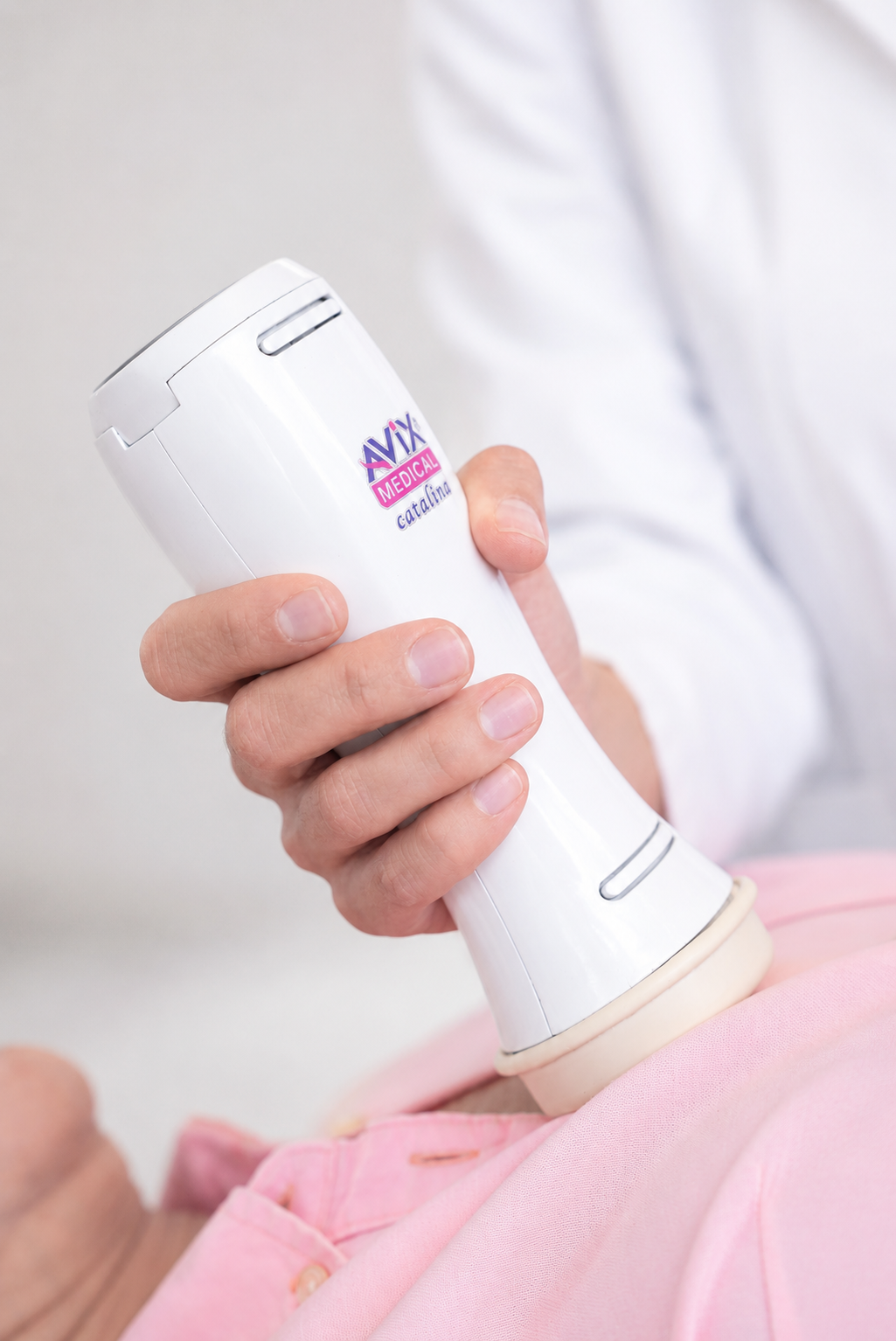
AVIX'S CATALINA
When a breast lump is found, getting an answer usually takes several appointments: an exam, then imaging, then a biopsy, then the wait for pathology. Among U.S. Medicare patients, the average wait from an abnormal mammogram to biopsy alone is 23 days, before pathology begins. In England, the NHS allows up to 28 days from an urgent breast referral to a diagnosis, and up to 62 days to the start of treatment.
Breast cancer is the most commonly diagnosed cancer in women worldwide, with 2.3 million new cases in 2022. Stage at diagnosis matters: in the U.S., five-year survival is 100% when breast cancer is still localized and 34% once it has spread to distant organs (NCI SEER, 2016–2022 data).
Catalina is designed to shorten the first step of that wait by giving clinicians quantitative information about a breast tumor during the exam itself. Advances in optical sensing and embedded computing have made it practical to build this into a handheld device small enough for any exam room, including clinics far from imaging. The research behind it has been developed at Temple University for more than a decade, and Avix holds the exclusive worldwide license. See the numbers.
MILESTONES
From lab prototype to handheld device.
Foundational tactile imaging technology developed at Temple University
Generation 1 prototype built at Temple University (2015)
Temple clinical study published in IEEE Sensors Journal (2018)
Generation 4 benchtop system built and tested in collaboration with Temple University
Avix Medical, Inc. founded (2023)
Exclusive worldwide license obtained from Temple University
FDA Pre-Submission meeting completed (2024)
Generation 6 handheld device, the current generation, in active development (2026)
Selected for the Harvard Alumni Entrepreneurs Accelerator, one of 12 companies chosen from more than 180 Harvard-founded companies
First place, Harvard Alumni Entrepreneurs Accelerator Demo Day (2026), as selected by the judging panel
Selected to compete at the Harvard Alumni Entrepreneurs Startup World Cup Regional Finals (September 2026)
NEWS & RECOGNITION
SELECTED
Avix was selected for the Harvard Alumni Entrepreneurs Accelerator as one of 12 companies from a pool of more than 180 Harvard-founded companies.
WON
Avix went on to win first place at the Accelerator's Demo Day in 2026, as selected by the judging panel.
ADVANCING
As the Demo Day winner, Avix advances to the Harvard Alumni Entrepreneurs Startup World Cup Regional Finals in September 2026, where the winner competes for a $1 million investment.